From a Generic Website to 3,020 Organic Clicks
Location
Toronto, ON
Timeline
October 2025 – April 2026
Author
Joydip Kirtunia
A website rebuild driven by search intent, topical mapping, visual semantics, and stronger information architecture.
Measurement note
Google Search Console reports clicks, not unique visitors. This report therefore uses the verified figure of 3,020 organic clicks. “2,000+ visitors” should only be published when confirmed separately in GA4.
Latest 3 months
Latest 3 months
181 → 3,020
15.4K → 373K
Executive Summary
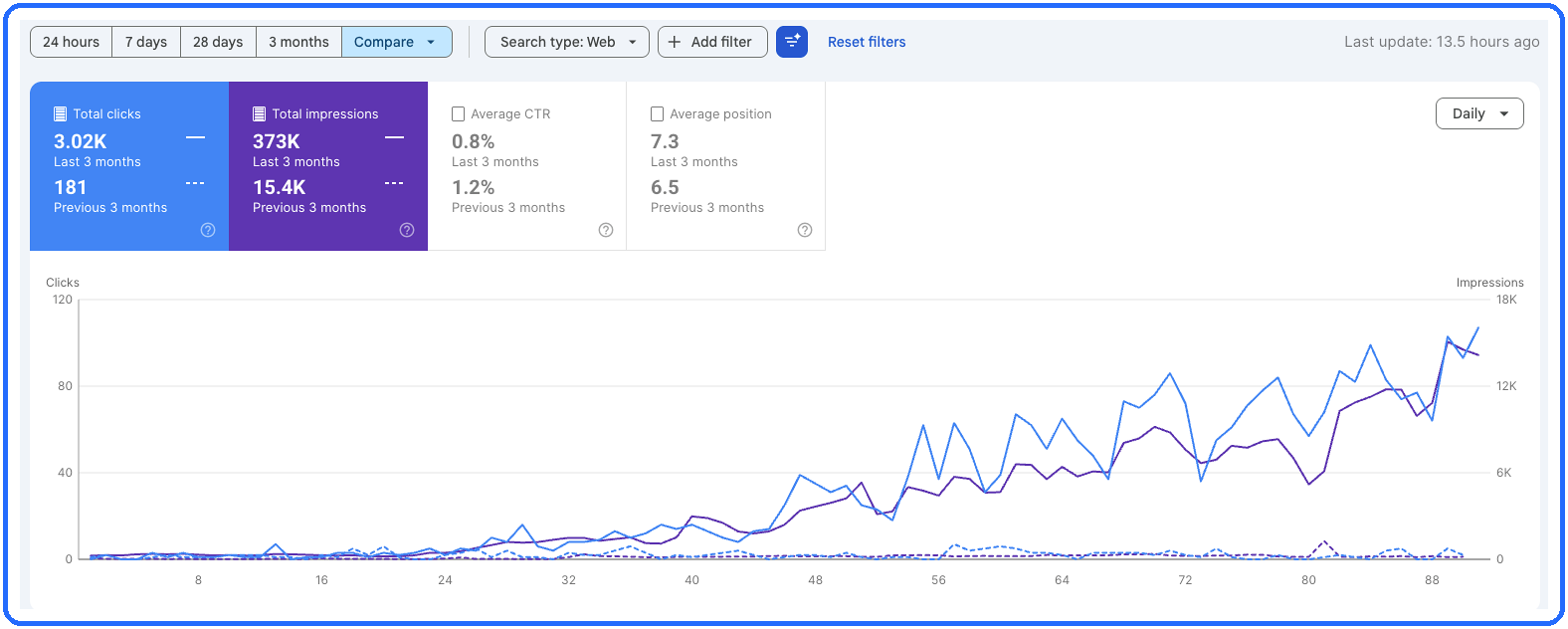
Within approximately four months of implementation, the website moved from a limited, generic search presence to a structured immigration resource capable of attracting thousands of organic clicks. The latest three-month period produced 3,020 Google Search clicks and 373,000 impressions, compared with 181 clicks and 15,400 impressions in the previous three-month period.
The growth did not come from publishing disconnected articles. It came from rebuilding the foundation: reorganizing the site around the firm’s actual services, mapping related topics, improving page design and comprehension, strengthening internal relationships, and aligning every important page with a clear search intent.
| Metric | Previous 3 Months | Latest 3 Months | Change |
|---|---|---|---|
| Organic clicks | 181 | 3,020 | +1,568% |
| Search impressions | 15.4K | 373K | +2,322% |
| Average CTR | 1.2% | 0.8% | Broader query reach |
| Average position | 6.5 | 7.3 | Page-one average |
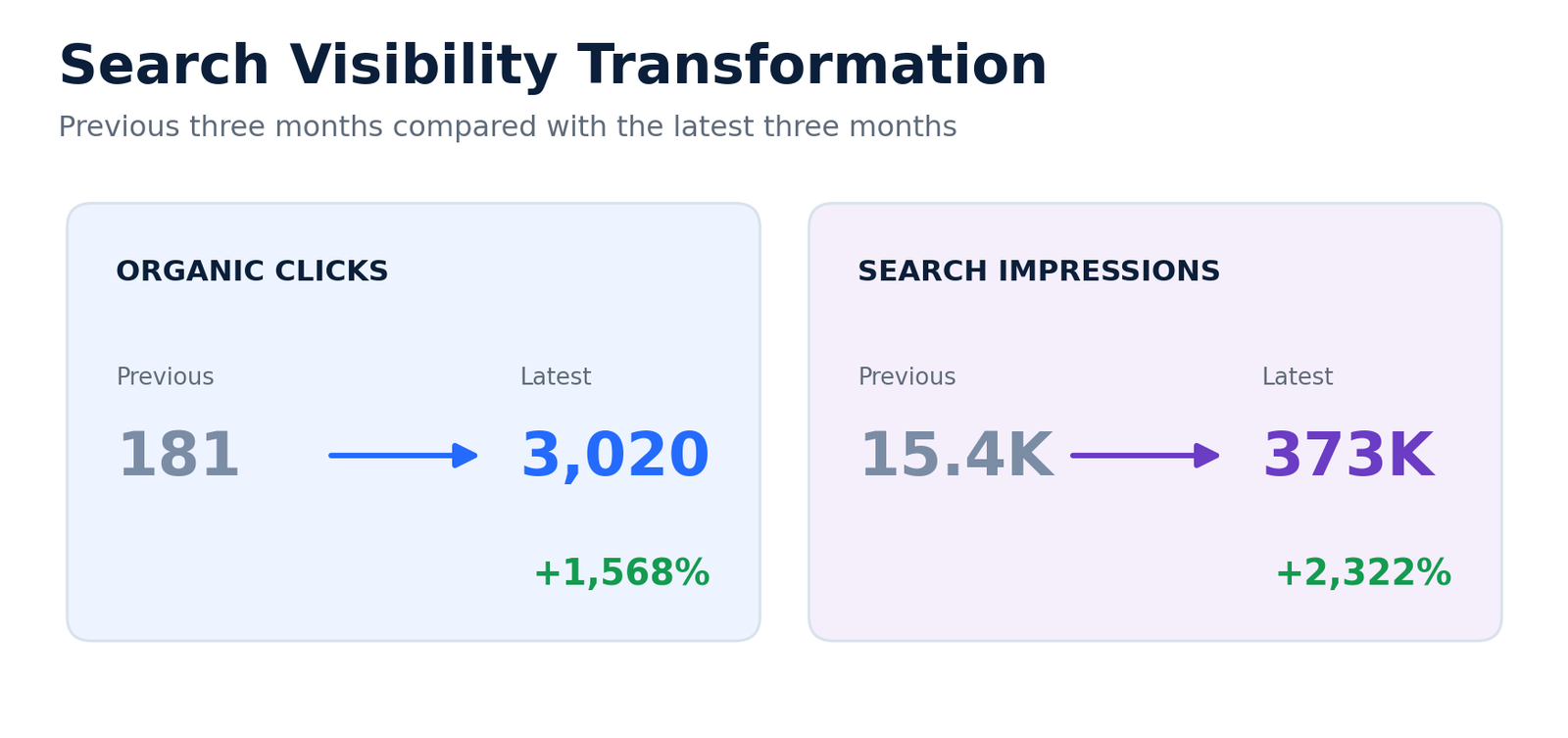
The site did not simply rank one page higher. It expanded the number of relevant searches for which Google could understand and surface the business. That wider footprint is why impressions and clicks scaled so sharply
The Starting Point
At the beginning of the engagement, the firm had a functional website, but it did not reflect the depth of its immigration services or provide search engines with a clear topical structure. Important services were grouped too broadly, the user journey was unclear, and the site lacked a repeatable system for building authority.
What was limiting growth
- A small number of broad, generic pages
- No clear relationship between parent services and subservices
- Limited coverage of high-intent immigration searches
- Weak internal-linking paths between related topics
- An unclear path from information to consultation
- No scalable framework for local and service expansion
What the site needed
- A service architecture based on real search intent
- Dedicated pages for major immigration pathways
- Supporting content that reinforces topical expertise
- A visual system that makes complex information easier to understand
- Strong internal relationships among services, FAQs and locations
- Clear conversion choices for different levels of client support

The Strategic Shift
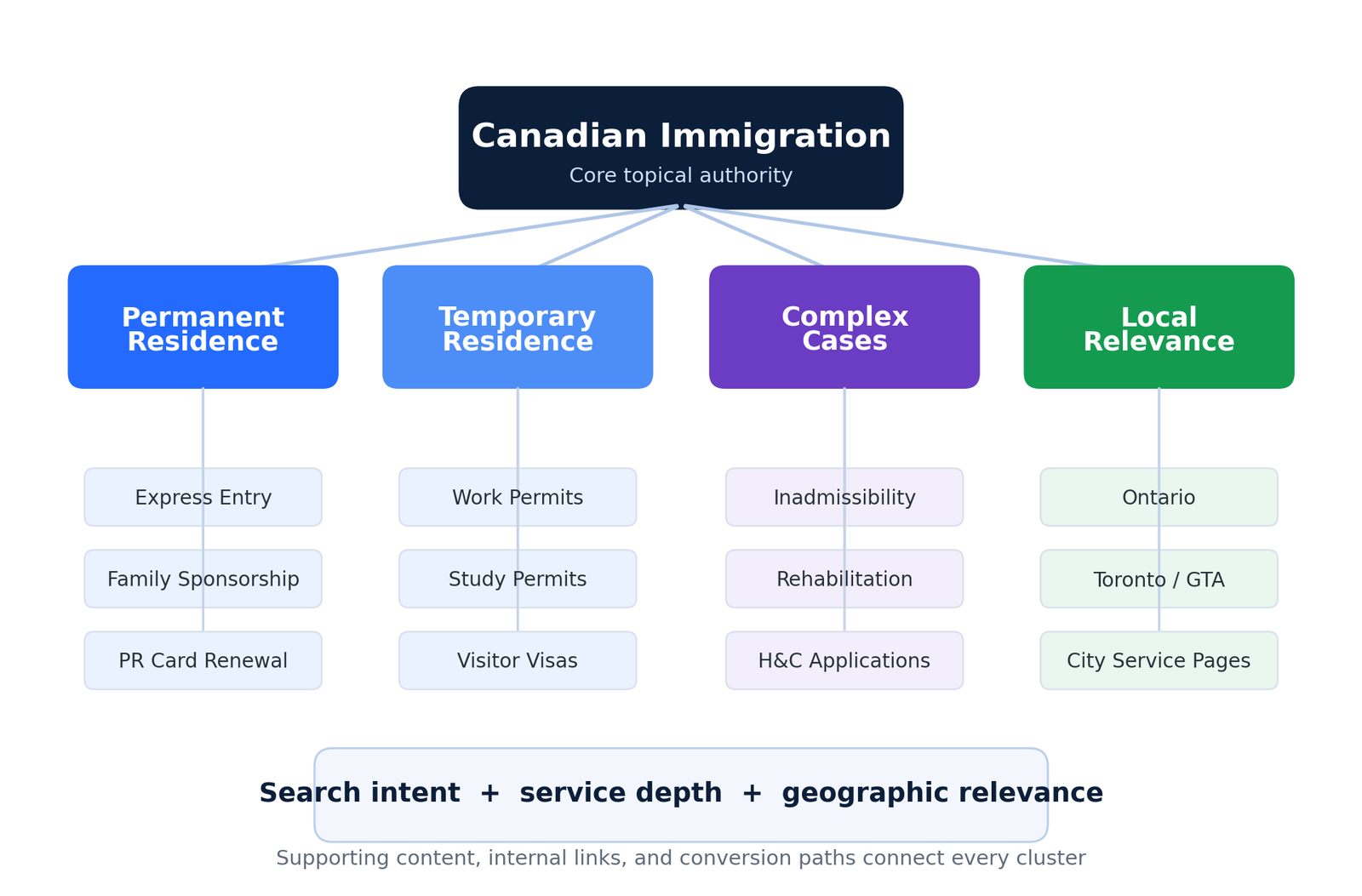
The project changed the website from a brochure into a structured search ecosystem. The new architecture grouped the firm’s work into clear clusters such as permanent residence, temporary residence, family sponsorship, citizenship, complex admissibility matters, and Ontario service areas. Each cluster could then support focused subpages, FAQs, internal links, and conversion paths.
What We Did
The work was completed as a connected sequence. Research informed the architecture; architecture informed the content; content informed internal links and conversion design; and performance data guided ongoing improvement.
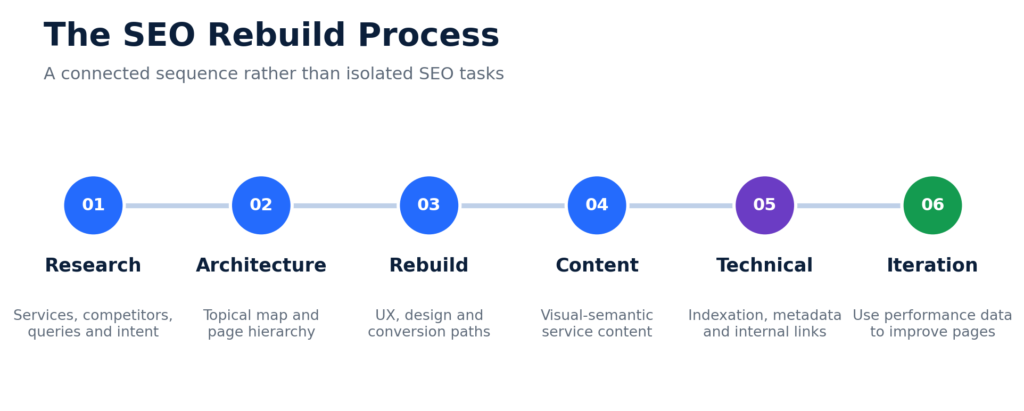
01
Research and opportunity mapping
Reviewed service priorities, competitor structures, user questions, commercial intent, local demand, and gaps in the existing site.
02
Topical map and information architecture
Defined service hubs, subservice pages, supporting topics, location relationships, and the internal paths connecting them.
03
Full website revamp
Reworked navigation, page hierarchy, visual flow, calls to action, and the overall journey from discovery to consultation.
04
Visual-semantic content development
Rewrote and expanded key pages so the layout, headings, entities, explanations, examples, and FAQs all reinforced the same topic.
05
Technical and on-page implementation
Improved crawlability, indexation signals, metadata, headings, internal links, mobile usability, and page-level consistency.
06
Measurement and iteration
Used Search Console performance to identify traction, broaden coverage, and improve pages using real query and visibility data.
The Visual-Semantic Approach
Immigration content is complex, high-stakes, and often difficult for users to navigate. Long blocks of text may contain useful information but still fail to create clarity. The rebuilt pages therefore combined semantic depth with visual structure, so users could scan, understand, compare options, and take action without losing the meaning of the topic.
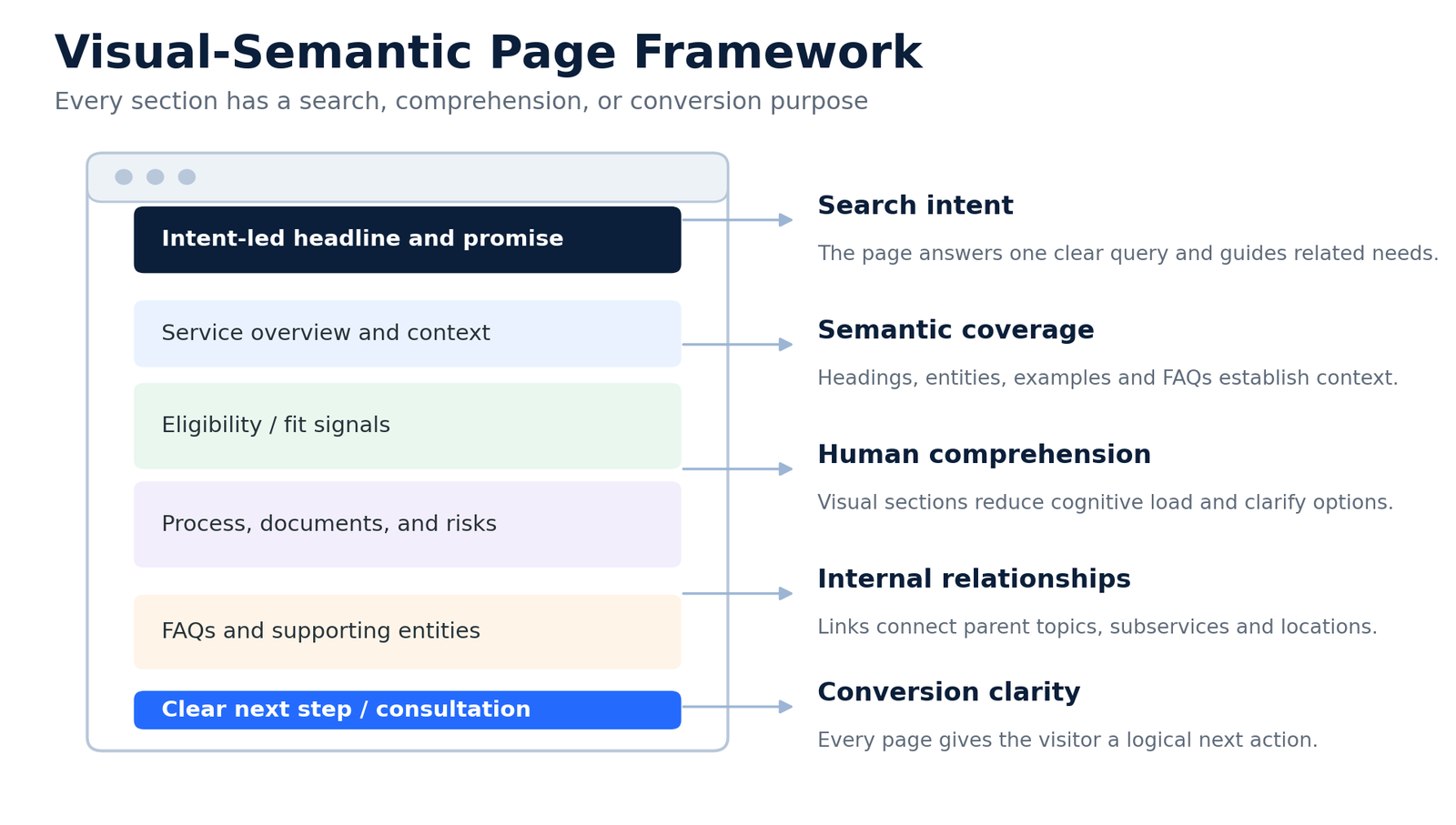
Page-level practices
- One clear primary intent per page, supported by closely related subquestions.
- Descriptive headings that establish hierarchy rather than simply inserting keywords.
- Eligibility, process, document, risk, pricing, and FAQ sections placed where users naturally need them.
- Relevant entities and terminology included in context, not as forced keyword repetition.
- Internal links that connect parent services, specific programs, complex-case topics, and local pages.
- Calls to action matched to the visitor's stage, including consultation and guided-intake options.
Performance Evidence
The performance curve changed after the rebuilt structure and content began to gain traction. The latest three-month window reached 3,020 organic clicks and 373,000 impressions. The chart also shows that the increase was sustained across the period rather than produced by one isolated spike.
How to interpret the metrics
Clicks
181 → 3,020
A 16.7-times increase in visits from Google Search results during the compared periods.
Impressions
15.4K → 373K
The site became eligible and visible for a far broader set of relevant searches.
CTR
1.2% → 0.8%
CTR decreased as visibility expanded rapidly into more queries and positions. This is common during footprint growth and creates an optimization opportunity.
Position
6.5 → 7.3
Average position remained around page one while Google tested and ranked the site across a much larger query set.
Why the Strategy Worked
The result came from aligning multiple systems around one objective: helping search engines and potential clients understand the firm’s expertise. The topical map created coverage, the site architecture created relationships, the visual-semantic content created clarity, and the technical work ensured those improvements could be discovered and interpreted..
Structure
Clear hubs, subservices and local relationships
Depth
Pages built around complete user needs and entities
Clarity
Visual sections that simplify complex decisions
Iteration
Real query data used to guide improvement
What this project teaches
- A generic website can limit growth even when the firm has strong real-world expertise.
- The site structure should reflect how services, subservices, problems, and locations relate to one another.
- Publishing content without a topical map often produces pages that compete, overlap, or remain disconnected.
- Design is part of SEO when it improves comprehension, hierarchy, trust, and the path to conversion.
- Rapid impression growth should be followed by CTR optimization, page refinement, and stronger conversion tracking.
- Stopping SEO after early traction risks losing the compounding value of the new structure and visibility.
Where to go from here
- To build on the current trajectory, the next phase should focus on improving click-through rate for high-impression queries, expanding the strongest service clusters, strengthening local relevance, updating pages based on Search Console query data, earning authoritative mentions and links, and measuring consultation quality through GA4 and CRM attribution.
Final outcome
The project transformed a limited website into a scalable organic-search asset. In the latest three-month period, it generated more than 3,000 clicks and 373,000 impressions while establishing a much clearer foundation for future service, content, and local growth.
START WITH US
Want a search foundation that compounds like this?
Whether your business is starting from zero visibility or looking to strengthen its presence across Google Search and AI-powered search platforms, a well-executed Local SEO strategy can generate sustainable long-term growth.
Immediate leads from day one
Google Ads
Complete local domination
GBP + Rankings
Long-term sustainable growth
SEO
Measurable ROI
On every dollar spent